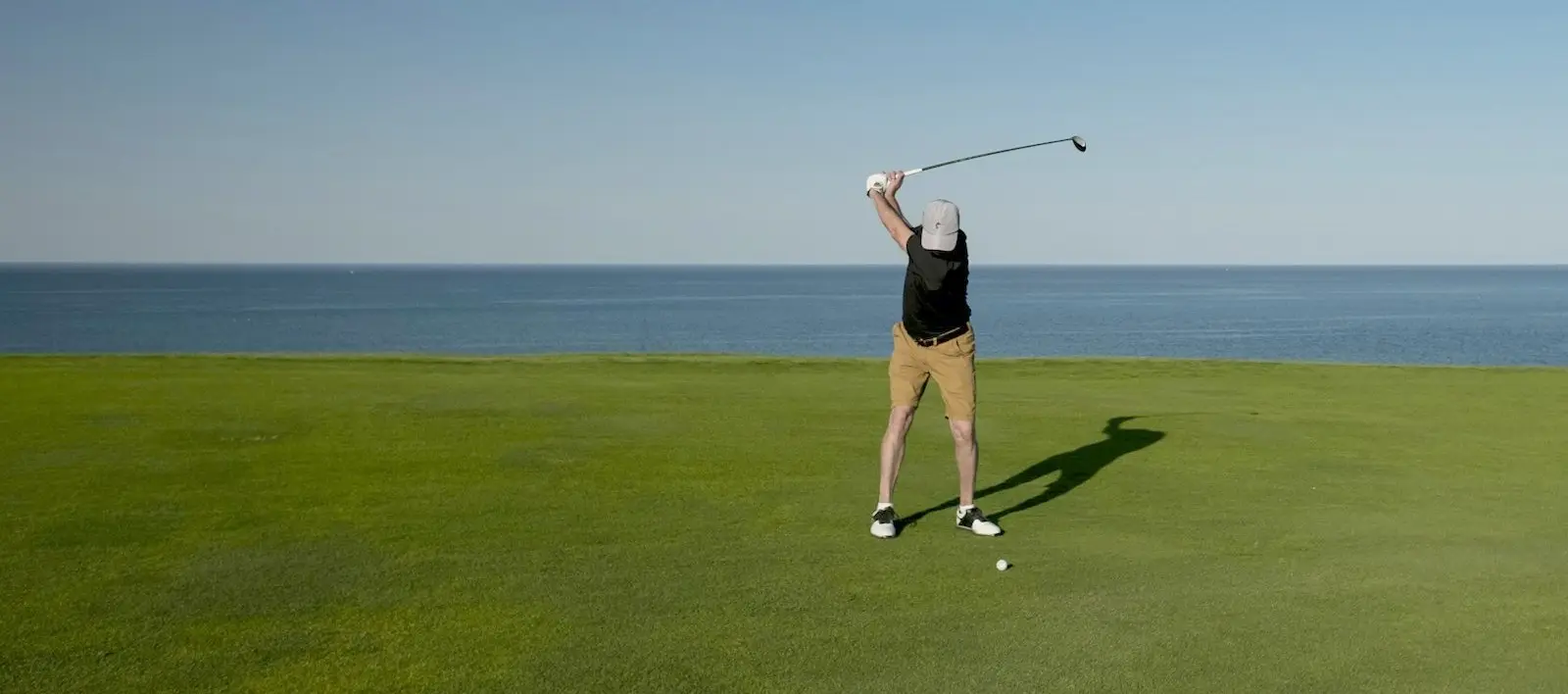
The swing, and who
pays for the rotation
Thirty-seven in a hundred male golfers had back pain last week. The single-figure handicaps were no better off.
Thirty-seven in a hundred male golfers had back pain last week. The single-figure handicaps were no better off.
Most golfers read a sore back as the price of playing a lot, or of playing badly. The survey does not hold either up.
One thousand one hundred and seventy male golfers, average age fifty-five, were asked what had hurt in the past week. The lower back came back at thirty-seven in a hundred (nearly three times the next thing on the list), and the low handicaps, who had started younger and practised more, were no better off. What separates golfers is not how well they swing. It is which part of them is currently supplying the rotation.
And the boundary is the same here as everywhere else on this site: if it turns out to need a diagnosis, a scan or a prescription, Jonathan will say so and point you to the person who can, rather than work around it.
Five segments the golf swing spends, and what happens when one of them will not. On three of the five, the thing that pays is your lower back.
This is the row where hands are most obviously relevant: the mid-back is stiff in soft tissue and in joint in roughly equal measure, and one of those two is reachable from a table.
→A mid-back that has stopped rotating is a specific complaint rather than a sore area. Named in advance, the hour opens on it.
Say it is the mid-back →On three of these five the thing that pays is your lower back, which is also, across one thousand one hundred and seventy male golfers, the most reported complaint in the sport by a distance. Thirty-seven in a hundred of them had it in the past week, and handicap made no difference to that at all.
The rotation is the sport. What a standing arrangement does is keep an eye on which segment is currently supplying it, so the answer does not quietly become your lower back by default.
Golfers tend to come every three or four weeks through the playing season, and most keep something going over the winter rather than stopping with the fixtures. The Rhythm: golfWhat a standing arrangement looks like
Take the commonest one, which is a mid-back that stops rotating partway up. Sixty-eight mid-back segments from twenty-nine donors were measured one level at a time. Each gives about five degrees of rotation, the lowest one three. The rotation is assembled from a dozen of them.
This is the row where hands are most obviously relevant: the mid-back is stiff in soft tissue and in joint in roughly equal measure, and one of those two is reachable from a table.
On three of these five the thing that pays is your lower back, which is also, across one thousand one hundred and seventy male golfers, the most reported complaint in the sport by a distance. Thirty-seven in a hundred of them had it in the past week, and handicap made no difference to that at all.
The rotation is the sport. What a standing arrangement does is keep an eye on which segment is currently supplying it, so the answer does not quietly become your lower back by default.
Golfers tend to come every three or four weeks through the playing season, and most keep something going over the winter rather than stopping with the fixtures. The Rhythm: golfWhat a standing arrangement looks like
Two of the five answers send you to a coach instead, or to nothing at all. Being told which, by somebody with no reason to say it, is most of a first hour.
Book a sessionFairly said. An hour on a table does not add distance and does not make anybody a better player; the rest of the field promises otherwise and none of them cites anything. What it can tell you is which segment of you is currently short, whether that is soft tissue or something a coach should be looking at, and when the answer is neither.
It usually means the thing that was supplying your rotation early on stopped, and something else took over. That is a description rather than a finding (nobody has measured your particular back nine), but it is the pattern the section above is about, and it is worth mentioning when you book, because "fine for two hours and then not" is more useful to work from than "my back hurts".
Sometimes, and it is worth knowing that the phrase describes what your body did, not why it did it. A hip that will not rotate and a habit that was never coached out both look identical on video. The cheaper one to rule out is the habit, and that is a conversation with your coach rather than with anybody here. If it has survived being coached at, then it is worth looking at what is actually available at the joint.
Because the back is usually where the bill arrives rather than where the spending happened. Fifteen professional golfers had their swings measured and the lumbar spine rotated about forty-five degrees, tracking both hips closely enough that they move as one system. When a hip or the mid-back will not rotate, the segment between them is what is left. That is why the instrument above starts from what will not move rather than from what aches.
Partly, and the honest version is more useful than either extreme. The survey behind this had an average age of fifty-five and a range up to eighty-four, so this is the sport's normal population rather than an exception. Tissue does take longer to recover than it used to. What that argues for is holding the range you have rather than accepting that it goes. And if what you actually have is pain that clicks, catches, gives way or wakes you up, that is a different question. Jonathan is not a physiotherapist and he will say so and point you at one rather than keep you on the table.
You leave knowing which segment is short, or knowing that is not what this is. Both are worth more than another season of guessing at it.
Book a sessionOr start from the situation rather than the sport: something already hurts, or nothing hurts yet.